+91 62 3267 0879





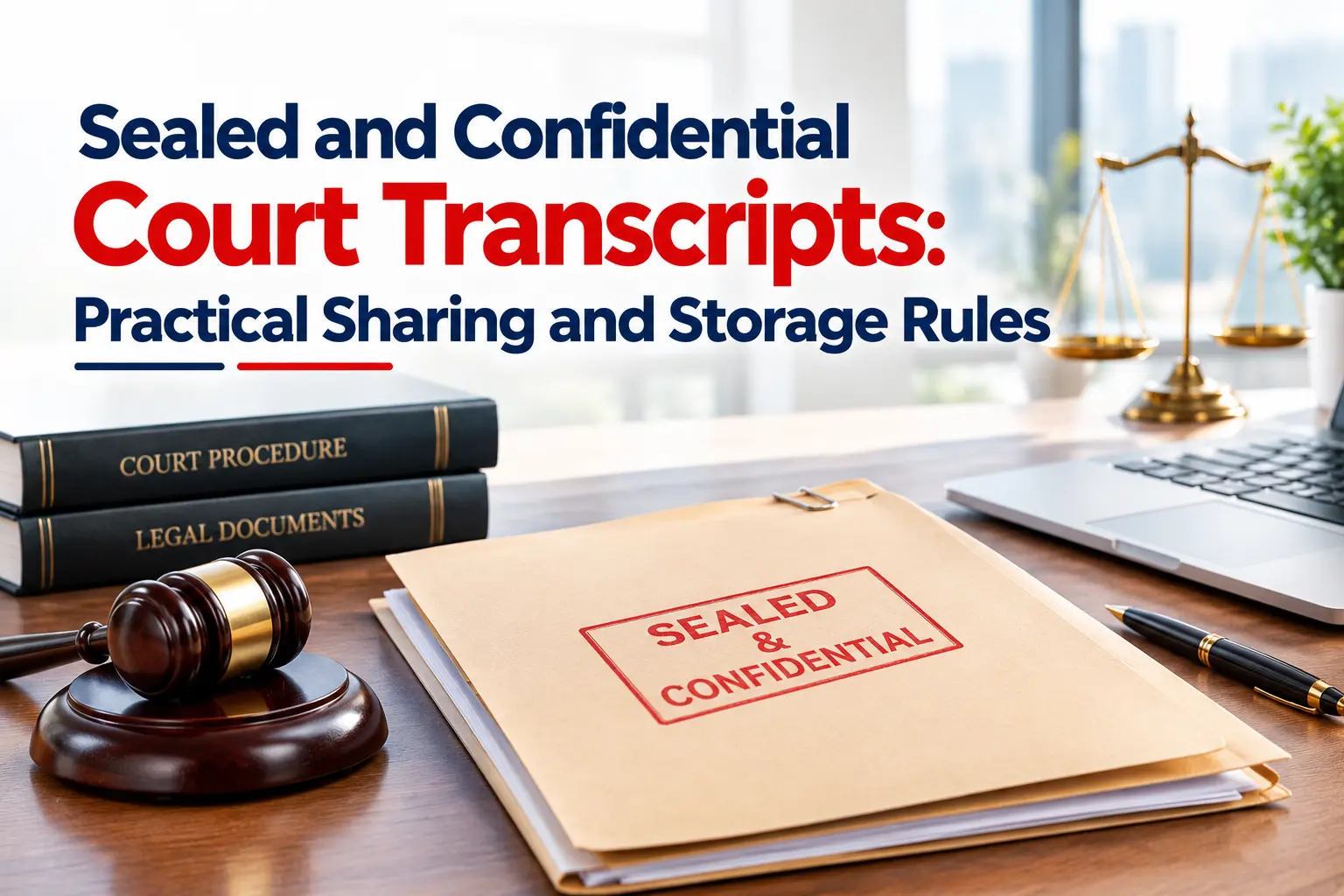
You can’t just email a sealed transcript to whoever asks for it. Confidential Court Transcripts carry private testimony, details about minors, or sensitive business information – and a judge has already decided that information doesn’t belong in public view. Court reporters, attorneys, and record custodians work under strict rules for storing and sharing these files. Break those rules, and you’re looking at a violation of a direct court order.
A custody dispute. A trade secret case. A criminal trial involving a minor. Any of these can produce Confidential Court Transcripts, and most law offices run into one sooner or later. Get the storage and sharing rules wrong, and the client and the firm both end up in legal trouble.
What Are Confidential Court Transcripts?
A judge’s order is what separates Confidential Court Transcripts from an ordinary court record. Anyone can request a standard record. These stay locked to the named parties, full stop.
Sealing usually comes up when a case touches on:
- Minors or juvenile proceedings
- Sensitive medical or psychological testimony
- Trade secret or intellectual property disputes
- Family law matters involving domestic violence
Sealed Transcripts don’t disappear from the court file – they just carry legal limits on who’s allowed to view or copy them.
Why Do Courts Seal Confidential Court Transcripts?
Privacy, personal safety, and active investigations are what push a judge to seal a transcript. The public has a right to open records, sure, but that right gets weighed against the real harm disclosure could cause someone named in the case.
A victim’s identity. A company’s trade secrets. Those are the two reasons that come up again and again behind an order for Sealed Transcripts. Once sealed, Confidential Court Transcripts stay locked under judicial control until the court says otherwise.
How Are Confidential Court Transcripts Stored Safely?
Encrypted digital systems and locked physical archives – that’s where Confidential Court Transcripts belong. A password slapped on a shared drive isn’t even close to the security bar courts expect here.
Solid storage habits look like this:
- Access logs tied to password-protected files
- Cloud storage that’s encrypted and cleared for legal use
- Sign-in sheets and locked cabinets for physical copies
- Regular audits tracking who viewed a record and when
World Doc Services, built around secure transcription and records handling, can take this workload off your staff entirely.
Who Can Access Confidential Court Transcripts?
The court order spells out exactly who gets access, and that list stays short. Attorneys of record and authorized court staff make up most of it. Everyone else needs written court permission first.
That circle typically includes:
- Judges and court clerks assigned to the case
- Attorneys of record for each party
- Expert witnesses under a confidentiality agreement
Even a genuine accident that puts these records in the wrong hands can trigger contempt of court charges. Intent doesn’t matter much here.
How Should Confidential Court Transcripts Be Shared With Other Parties?
Only secure, trackable channels should ever carry Confidential Court Transcripts between approved parties. A printed copy left on a desk, or a regular email attachment, is a risk nobody needs to take.
| Sharing Method | Security Level | Best Suited For |
| Encrypted email | High | Attorney-to-attorney transfers |
| Secure client portal | High | Client review access |
| Standard email | Low | Not recommended |
| Physical courier with signature | Medium | Court filings |
| Public cloud link | Low | Not recommended |
One firm-wide protocol stops staff from reaching for whatever feels convenient at the moment.
For situations where documents need to be shared digitally, it is also useful to understand how secure electronic document delivery can help protect sensitive records during transmission.
What Happens If Confidential Court Transcripts Are Leaked?
A leak can trigger contempt of court penalties, sanctions, and lasting damage to a case. Courts don’t shrug this off. A sealing order exists for a legal reason, not as a suggestion someone can ignore.
Fines and disciplinary action are the usual fallout when Sealed Transcripts get mishandled. Push it further, and criminal charges enter the picture. A harmed client can also file a civil claim against the responsible firm.
How Can Law Firms Manage Confidential Court Transcripts Efficiently?
A transcription partner that already understands sealed record protocols is how many firms keep Confidential Court Transcripts under control without eating up staff hours. That partnership cuts internal workload while keeping compliance intact.
A few habits make a real difference:
- One staff member assigned to oversee sealed record requests
- Team-wide training on transcript handling policy
- A specialized provider like World Doc Services for secure storage
- Quarterly reviews of access logs
Stay consistent with this, and small mistakes rarely turn into major compliance failures.
You can also follow us on Facebook, Instagram, Pinterest, and YouTube for more updates and insights.
Also Read: Sealed Transcripts for USA Universities – Exactly What USIEF, WES, and Admissions Offices Require
Frequently Asked Questions
Can a client request a copy of Confidential Court Transcripts?
Yes, through their attorney, if the court order allows it.
How long do courts keep Sealed Transcripts sealed?
It varies by case and court order – sometimes a few months, sometimes permanent.
Can Confidential Court Transcripts be unsealed later?
Yes. A party can file a motion asking the court to lift the seal.
Do paralegals have access to Sealed Transcripts?
Only when the court order or firm policy specifically permits it.
What is the difference between sealed and confidential transcripts?
Sealed transcripts carry court-ordered restrictions. Confidential transcripts can involve broader privacy protections beyond what a court has ordered.






 Call Us
 Mail Us
 WhatsApp