+91 62 3267 0879





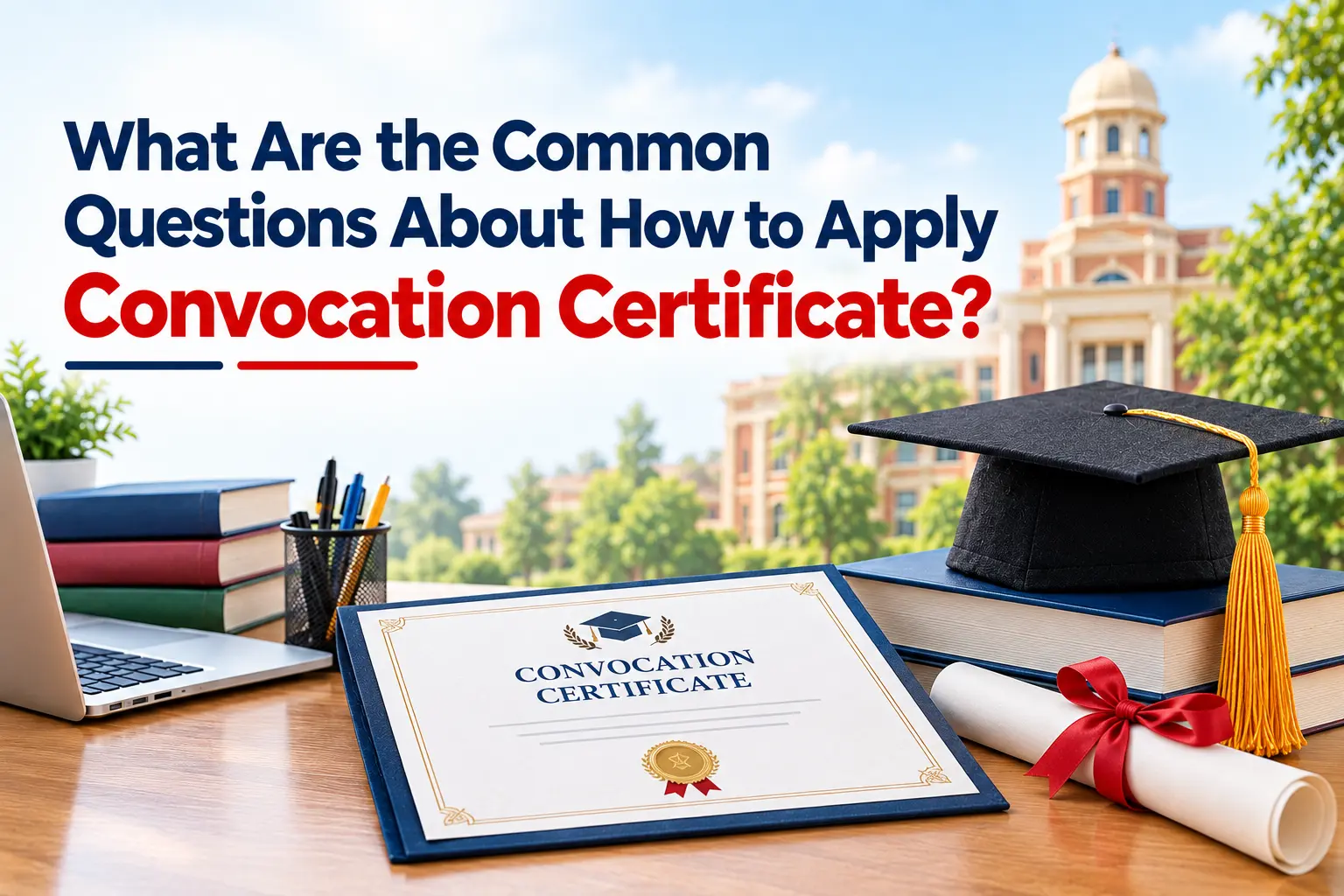
A Convocation Certificate is the document your university gives out at the convocation ceremony, confirming you actually completed your degree. Most students apply for it through the examination or registrar office, either online or by walking in.
What Is a Convocation Certificate?
It’s proof that you attended your university’s convocation and formally received your degree. Universities issue it once your final results are out and the academic council has approved your degree.
People often mix this up with the degree certificate, but they’re not the same thing. One marks your participation in the ceremony. The other is your actual academic qualification.
Here’s what typically shows up on it:
- Your full name, exactly as registered
- Course and specialisation
- Year of passing, plus the convocation date
- University seal with the registrar’s signature
- A unique number you can use to verify it later
Why Do You Need a Convocation Certificate?
Mostly for admissions abroad, government job applications, and some visa processes. A lot of institutions ask for it alongside your degree certificate as proof you actually graduated.
Certain employers request it too, especially for government or public sector roles, during background checks. Skip it, and your degree file can look incomplete even when your degree itself is completely valid.
Students heading to foreign universities run into this often – overseas admission boards tend to treat it as extra proof of authenticity, on top of the degree certificate itself.
How Can You Apply for a Convocation Certificate?
Through your university’s examination department – either by showing up at the convocation, or applying in absentia if you can’t make it. Most universities let you do this online now.
Here’s roughly how it goes:
- Fill out the convocation form on the student portal
- Pay the fee, usually through whatever mode the university lists
- Upload your mark sheets and ID proof as scanned copies
- Get the form in before the deadline
- Check your status through the student login once it’s submitted
Missed the ceremony itself? You can still get the certificate through the in-absentia route. Most universities keep that window open year-round, not just around convocation season.
What Documents Are Required for a Convocation Certificate?
Final mark sheets, a provisional degree certificate, and valid photo ID cover the basics of what a Convocation Certificate application needs. Some universities want migration certificate copies too, depending on their process.
A fairly standard checklist looks like this:
- Provisional degree certificate from your final semester
- Mark sheets, all semesters or years, whichever applies
- Photographs sized to the university’s specifications
- A government photo ID
- Receipt for the application fee
Get these together beforehand, and the application itself takes far less time.
How Long Does It Take to Get a Convocation Certificate?
Somewhere between four and twelve weeks, usually, depending on the university and how you applied. Attend in person, and some universities hand it over the same day.
Delays tend to come from incomplete forms, fees stuck in processing, or a backlog at the examination office. Apply early, and most of that disappears on its own.
What Is the Difference Between a Convocation Certificate and a Degree Certificate?
One confirms you were at the graduation ceremony. The other is your permanent proof of academic qualification. They work together, but they’re not interchangeable.
| Factor | Convocation Certificate | Degree Certificate |
| Purpose | Shows you attended the ceremony | Records your actual qualification |
| Issued When | On or after convocation day | Once final results are out |
| Usage | Backup proof for admissions or jobs | The main academic document |
| Validity | Supporting paperwork | Valid for life |
| Requirement | Sometimes optional | Almost always mandatory |
If your university has already closed, this guide on getting a convocation certificate from a closed university explains where your records may be transferred and what steps you can take to obtain the certificate.
Where Can You Get Help With a Convocation Certificate?
Your university’s examination cell is the first stop, though document assistance services help for your convocation certificate if the process feels like a maze. A fair number of students go this route just to save time.
Services such as World Doc Services handle document verification, attestation, and certificate paperwork, which comes in handy if your university’s process is dragging or unclear.
Your alumni office is worth a call too – they’ve usually dealt with delayed or missed convocation cases before, and know the shortcuts.
Frequently Asked Questions
Can I get a Convocation Certificate without attending the ceremony?
Yes, universities generally let you apply in absentia through the examination department.
Is a Convocation Certificate the same as a degree certificate?
No, one confirms ceremony attendance and the other is your core academic qualification proof.
How much does a Convocation Certificate usually cost?
It varies by university, typically somewhere between a few hundred and a few thousand rupees.
Can I apply years after graduating?
Yes, most universities accept late applications, though it may take longer to process.
Is a Convocation Certificate mandatory for job applications?
Not always, but some employers and foreign universities specifically ask for one.
For more helpful insights on academic documentation, connect with World Document Services on Facebook, Instagram, Pinterest, and YouTube.
 Call Us
 Mail Us
 WhatsApp