+91 62 3267 0879





You got your admit. Or maybe you are still working on your application. Either way, at some point, someone asks, “Can you send your official transcripts?”
And that is when the panic starts.
Where do you even go? Which office handles this? How long will it take? Does it need a stamp? Which stamp? Do you have to go back to your college in person?
These are real questions that thousands of students deal with every year. And most of them figure it out way later than they should have. This guide walks you through how university transcript services work, step by step, so you are not the person scrambling two days before the deadline.
First Things First – What Actually Is a University Transcript?
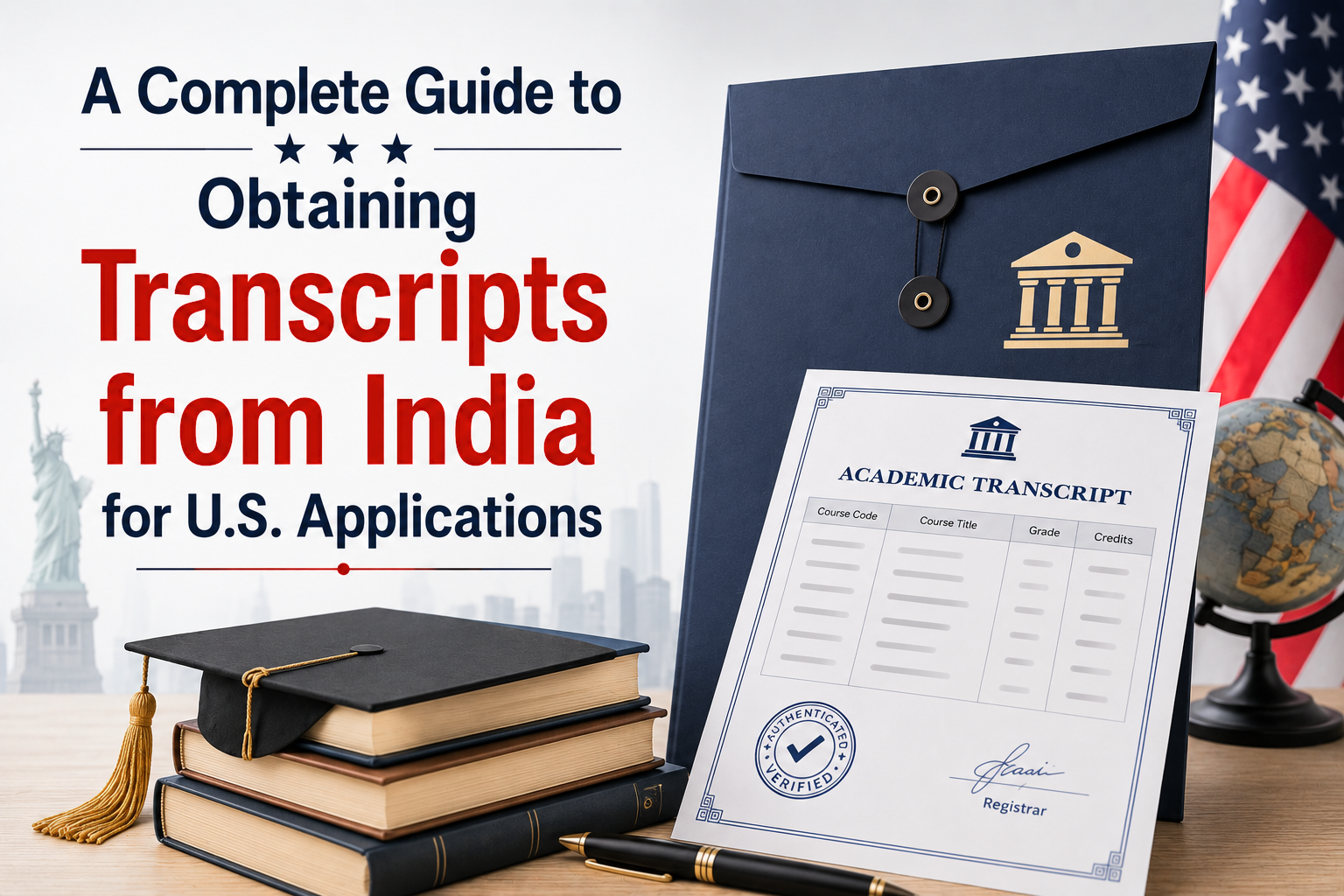
A university transcript is the official record of everything you studied and scored during your degree. Every subject, every semester, every grade – all of it in one document, issued directly by your university.
Foreign universities, embassies, and employers ask for this because it is the most authentic proof of your academic history. Your marksheets alone usually do not cut it for international purposes.
The document itself is straightforward. Getting it in the right format, with the right authentication, delivered to the right place – that is where it gets complicated.
Why So Many Students Turn to University Transcript Services
Most people start by going to their university’s exam cell or registrar’s office. They ask for transcripts, submit a form, pay the fee, and wait.
Sometimes that works. Often it does not – at least not smoothly.
A few things that typically go wrong:
- The university issues transcripts in a format that foreign institutions do not accept
- The document needs HRD attestation or apostille, which is a whole separate process
- The student has already moved cities or is currently outside India
- The admin office takes six to eight weeks, and there is no way to track anything
- The receiving university has a specific portal or envelope format requirement that your college has never heard of
University transcript services handle all of this. They know the process, they have contacts at universities across India, and they make sure the document reaches the right place in the right format – without you having to run around.
The Actual Process – Step by Step
Here is how university transcript services work from the moment you reach out to the moment your document is delivered.
Step 1 – Submit Your Request
You contact the service – usually through their website – and share your details. This includes your university name, course, graduation year, number of copies needed, and where the transcripts need to go.
Most services have a simple online form. You upload your ID and some basic enrollment proof, and that is your part done for now.
Step 2 – They Verify Your Details
Before anything moves forward, the service checks your information. Some of them coordinate directly with your university’s registrar to confirm your record. Others ask you to arrange a basic copy first, which they then take through the official process.
This step exists so that nothing comes back rejected later because of a mismatch in your name or roll number.
Step 3 – Collection from Your University
This is the step that saves students the most trouble. The service either sends someone to your university or uses their existing contacts there to collect the officially issued transcript.
If you are sitting in Canada or Bangalore, trying to get documents from a college in Lucknow or Coimbatore, this step alone makes the whole thing worth it. You do not go anywhere. They handle it.
Step 4 – Attestation or Apostille (If Your Destination Requires It)
This is where things get a bit technical, but the service explains what you need based on your destination country.
- State or HRD attestation – Your transcript gets verified by the state education department or the Ministry of Education, confirming it is genuine
- Apostille – Needed for countries that follow the Hague Convention. This is a special stamp that makes your document officially recognized internationally
- Embassy attestation – A few countries want their own embassy in India to verify the document on top of everything else
University transcript services know which combination applies to which country. You do not have to research this yourself.
Step 5 – Formatting for the Receiving Institution
Some universities abroad want transcripts uploaded to their application portal as a PDF. Others want physical copies in a sealed envelope signed across the flap by the registrar. Some want both.
A good service checks these requirements before sending anything. This detail alone prevents a lot of rejections.
Step 6 – Delivery
The transcript goes out – directly to the university, the visa office, or back to you, depending on what was agreed. Physical courier with tracking or secure digital delivery, both options are usually available.
You get a tracking number and can follow the document until it reaches its destination.
How Much Time Should You Expect?
This depends on your university and what kind of attestation is needed. A rough idea:
- Basic transcript collection from the university – 5 to 10 working days
- State or HRD attestation – another 7 to 15 working days
- Apostille – another 5 to 10 working days
- Embassy attestation – varies, but usually 10 to 20 working days
Express options exist if your deadline is close. They cost more, but they move faster.
The one thing every student learns the hard way: start earlier than you think you need to. Transcript issues are one of the top reasons students miss application windows.
Documents You Will Need to Keep Ready
Different services ask for slightly different things, but most need:
- Degree certificate or provisional certificate
- All semester marksheets
- Government ID – Aadhaar, passport, or PAN
- Your enrollment or roll number
- Full name and address of the institution receiving the transcript
Scan all of these before you reach out. Having them ready cuts the back-and-forth by a few days.
Choosing the Right University Transcript Service
Some services are better than others. Before you pick one, check these things:
- Do they work with your university? – Some colleges are tricky, and not every service has contacts there
- Do they know your destination country’s requirements? – Each country has different rules
- What is their usual turnaround? – Make sure it fits your deadline
- Can you track your document? – You should never be left guessing
- What do other students say? – Look for reviews from people who applied to similar countries or universities
A proper university transcript service will give you straight answers on all of this before you pay anything.
Wrapping Up
Transcripts feel like a small box to tick when you first look at your application checklist. And then you actually try to get them and realize how many moving parts are involved.
University transcript services take all of that off your plate. The collection, the attestation, the formatting, the delivery – they manage it so your focus stays on the rest of your application.
Start this process early. A few weeks of buffer can be the difference between making a deadline and missing it entirely.
Applying abroad? Our marksheet transcript services help students collect, verify, and deliver official university documents without the hassle.
FAQs
Q1. Can I get my transcripts without going back to my university?
Yes, that is the whole point of using a transcript service. They send someone on your behalf and handle everything remotely.
Q2. Will foreign universities accept transcripts from a third-party service?
Yes, as long as the transcript is officially issued and properly sealed or attested. Just double-check the specific requirements of the university you are applying to.
Q3. What is the difference between attestation and apostille?
Attestation is a government stamp confirming the document is real. An apostille is an international version of that, accepted by countries in the Hague Convention. Which one you need depends on where you are going.
Q4. How many transcript copies should I order?
Order more than you think you need – at least three to four extra. Getting additional copies later means repeating the whole process, which nobody wants.
Q5. What if my college shuts down or merges with another university?
Some services handle this. It takes longer and needs more documentation, but records from closed institutions can usually still be retrieved.
Follow us on Instagram for study abroad document tips, transcript updates, and university application guidance.






 Call Us
 Mail Us
 WhatsApp