+91 62 3267 0879





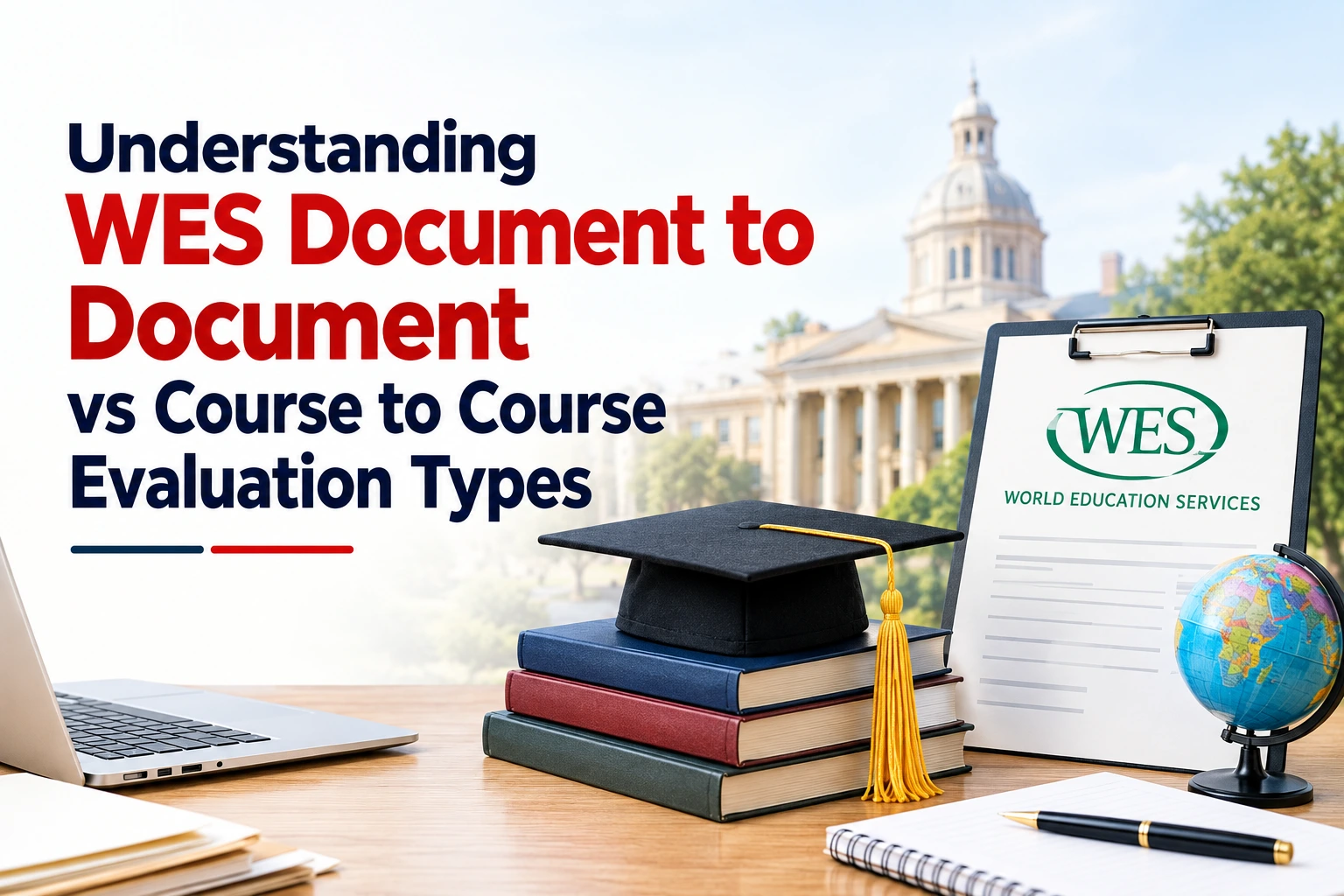
WES Document to Document evaluation checks whether your degree is genuine and matches an equivalent credential in the United States or Canada. It does not look at individual subjects.
Course to Course Evaluation does the opposite. It goes subject by subject, matching what you studied with a comparable course abroad.
Picking the wrong one can cost you weeks. Immigration officers usually want one thing, and university admission boards want another, so it pays to know the difference before you apply.
What Is WES Document to Document Evaluation?
WES Document to Document evaluation verifies your degree as a whole and confirms its value abroad, without listing every course or grade you earned.
Think of it as a stamp on your overall qualification, not a line-by-line report card. WES checks that your institution is recognised and your degree is authentic, then issues a report confirming its equivalent credential in North America.
Most people request this evaluation for immigration, not for study. Since it skips subject-level detail, it also tends to move faster than the alternative.
Where this evaluation is typically used:
- Express Entry and Canada PR applications
- General skilled migration files
- Job applications that only need degree verification
- Any case where course-level detail simply isn’t asked for
What Is Course to Course Evaluation?
Course to Course Evaluation breaks your transcript down into individual subjects and matches each one with an equivalent course abroad.
This is the detailed version. Every course, every credit hour, and every grade gets compared against its foreign equivalent, which naturally takes longer to prepare and review.
Universities rely on this level of detail because admission often depends on whether your prior coursework matches what a program expects. Licensing boards work the same way, especially in regulated professions.
Where this evaluation is typically used:
- University admission for further studies
- Professional licensing in regulated fields
- Credit transfer between institutions
- Employers who need subject-level proof, not just a degree summary
How Is WES Document to Document Different From Course to Course Evaluation?
The short version: WES Document to Document confirms your overall degree is equivalent, while the course-based option checks each subject on its own.
| Feature | WES Document to Document | Course to Course Evaluation |
| Level of detail | Overall degree only | Subject by subject |
| Common use | Immigration, PR applications | University admission, licensing |
| Processing time | Comparatively faster | Comparatively slower |
| Cost | Lower | Higher |
| Documents needed | Degree and transcript | Full transcript with syllabus |
Neither option is better on paper. It really depends on who is asking for the evaluation and why.
Which Evaluation Type Should You Choose for Canada PR?
For most Canada PR applications, WES Document to Document evaluation is enough, since immigration authorities usually only need proof that your degree is equivalent.
The course-based option only becomes necessary when a specific licensing body or employer asks for subject-level detail, which is uncommon in standard PR files.
Still, don’t guess. Check the exact wording of the immigration program’s requirement, or ask the institution directly, before you pay for either evaluation.
Reasons applicants usually pick WES Document to Document evaluation:
- It processes faster than the subject-based method
- Fees are lower for standard immigration files
- It’s sufficient for most points-based immigration systems
- Document requirements stay simple
You can also check the Marksheet Transcripts service for more information about getting your academic documents prepared for official use.
What Documents Are Required for Each Evaluation Type?
WES Document to Document evaluation needs your degree certificate and an official transcript. Course to Course Evaluation asks for that plus subject-wise records, including course syllabi.
What you’ll typically need:
- Degree certificate from your university
- Official transcript, sent directly by the institution
- Course syllabus, only if you’re going for the subject-based route
- Proof of identity that matches your academic records
Most delays come down to one thing: missing paperwork. That holds true whether you’re applying for WES Document to Document or Course to Course Evaluation.
For students applying to universities or credential evaluation agencies, our Electronic Transcripts service can help with digital academic document requirements.
How Long Does Each Evaluation Type Take to Process?
WES Document to Document evaluation usually clears faster than the subject-based method, mainly because there’s less to verify.
A lot also depends on your university. If they’re slow to confirm records, your timeline slips no matter which evaluation you choose, so request transcripts well before any deadline.
You can track your application at every stage through the WES online portal. Agencies such as World Doc Services also help applicants prepare accurate files upfront, which cuts down on avoidable back-and-forth.
Frequently Asked Questions
Is WES Document to Document evaluation enough for Canada PR?
Yes, most Canada PR programs accept it as sufficient proof of degree equivalency.
Does Course to Course Evaluation cost more than Document to Document?
Generally, yes. The subject-level detail takes more work to assess, so it costs more.
Can I upgrade from WES Document to Document to Course to Course Evaluation later?
Yes, you can request the detailed evaluation separately if an institution later asks for subject-level proof.
How long does WES Document to Document evaluation take?
Usually a few weeks, though the exact time depends on how quickly your university responds to verification requests.
Which evaluation type do universities usually require?
Most universities ask for Course to Course Evaluation, since admission decisions depend on subject-level comparison.
Don’t miss out — connect with World Document Services on Facebook, Instagram, Pinterest, and YouTube to get the latest news and helpful insights on academic document services.

 Call Us
 Mail Us
 WhatsApp