by World Document Services | Aug 11, 2025 | Document Verification
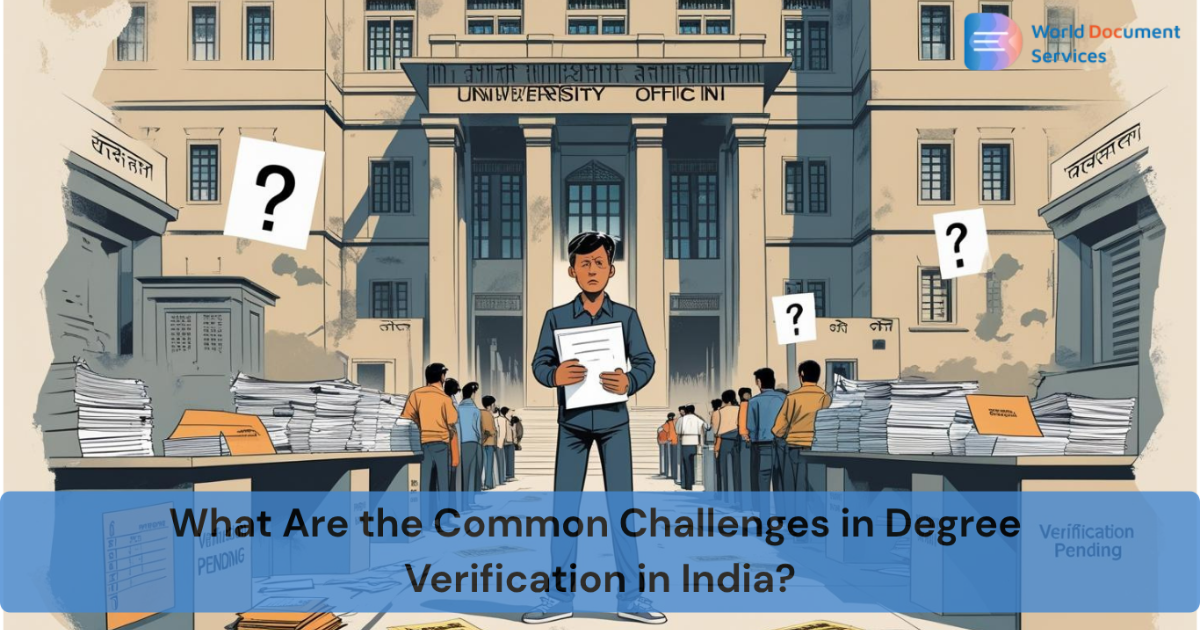
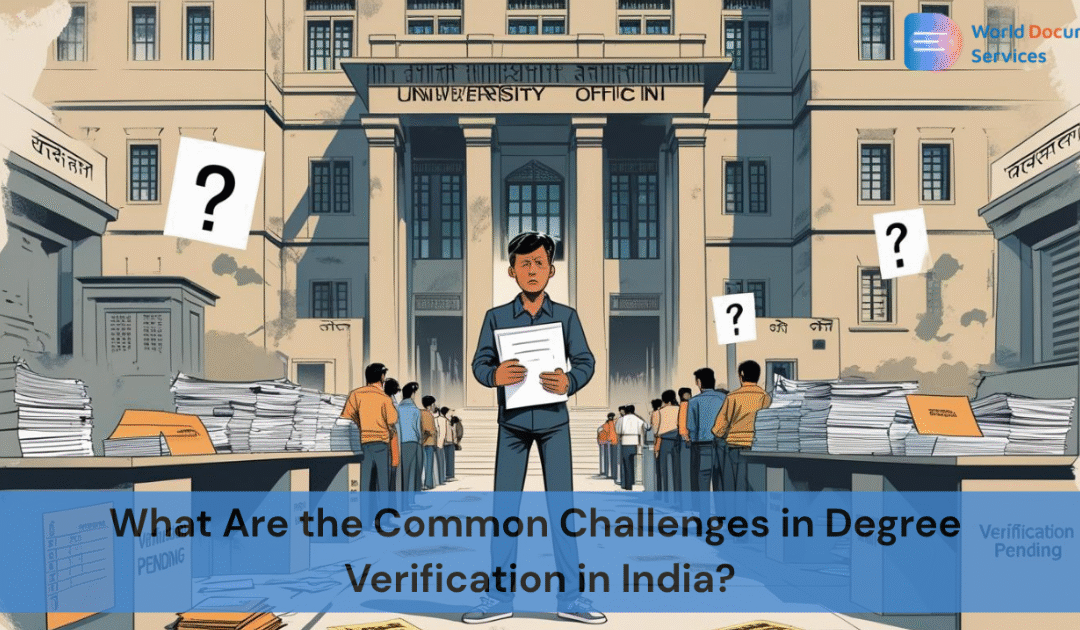
Degree verification is an important process in matters of migration, whether for employment or educational purposes. This is a lengthy process that involves multiple steps, starting from contacting the university to getting the entire process sorted, concluding it by getting your degree verified. However, this process is lengthy, has its own challenges, and creates many issues such as inaccuracies, errors, and delays, which often are a trouble to the applicant.
Need help with your Degree Verification? Contact Us Now!
1. Lack of a Centralized Degree Verification System
One of the biggest challenges in India is the absence of a centralized record system for academic credentials. With thousands of universities and colleges maintaining separate records, accessing verification data becomes cumbersome. Unlike some developed nations with unified academic databases, India’s fragmented system causes delays and inefficiencies. Establishing a centralized database would streamline the verification process, making it more efficient and accessible.
2. Manual and Paper-Based Processes
Many universities in India are still functioning on traditional paper-based record-keeping of documents or maintaining the records, which is now pretty outdated as well as less reliable. Keeping an outdated working pattern slows down the entire verification process, making it less reliable and error-free. Having a paper-based record increases the chances of misplacement and errors in the records.
3. Inconsistent Verification Procedures
The degree verification process varies and differs entirely from university to university. Some institutes have a traditional way of bookkeeping, while others have a modern one. Some universities do not have a predefined process for a degree; some have methods that one can follow and obtain. This inconsistency leads to delay, and only proper planning can help you avoid this delay.
4. Delays in Response from Universities
A common issue in academic credential verification is the prolonged response time from universities. Due to multiple drawbacks and inefficiencies, understaffed departments, and administrative bottlenecks, it can take weeks or even months to process verification requests. These delays can negatively impact job opportunities, admission timelines, and visa applications.
5. Forgery and Fraudulent Degrees
Fake degree certificates and fraudulent academic claims are widespread in India. Many individuals attempt to avoid verification by presenting fraudulent documents. This has made it essential for organizations to implement a strict degree verification process. Figuring out the genuine credentials from fraudulent ones still remains a challenge, especially when universities lack a transparent and uniform verification system.
6. Limited Digital Infrastructure
Some universities, along with time, have developed and started to maintain the digital verification method, while others are still enticed by the traditional paperback method of verification. In the absence of digital methods and uniform methods, many individuals are forced to rely upon postal communication, which is also inefficient and makes the entire process a hassle.
7. High Verification Costs
The cost of verification again is similarly a barrier for individuals and organizations, as these universities have varied and scattered fee systems. Some institutes charge the fees for verification along with the application of transcripts, while others consider it an individual cost. The verified degree to be sent to a domestic address or to an international employer is also a point where the cost will differ.
8. Complexity in Verifying Foreign Degrees
For Indian students who have studied abroad, verifying foreign degrees can be even more complicated.
Validation from international institutes for the student who has followed the Indian educational system. Lacking a uniform system makes the entire process lengthy and creates a long waiting list and waiting periods.
9. Limited Awareness and Guidance
Many students and professionals planning to move abroad and are planning to pursue their career ahead are unaware of the fact that there’s a step, such as degree verification. A lack of such information makes it difficult for one to understand the correct degree verification process and struggle to find the right one as well. Unclear guidelines from the university make it difficult for one to obtain the documents verified on time, as well as make the process complicated.
10. Data Privacy and Security Concerns
With increasing digitization, data security is a major concern in academic credential verification. Universities and verification agencies must ensure that personal and educational data are protected from cyber threats and unauthorized access. The risk of data breaches or misuse of sensitive academic records discourages institutions from fully adopting digital verification methods.
Solutions to Improve the Degree Verification Process in India
While challenges persist, several measures can enhance and streamline the degree verification process:
- Centralized Database: A common database for academic records would simplify verification and reduce inconsistencies.
- Digital verification methods: Universities must start to use blockchain-based verification systems to enhance efficiency and reduce fraud.
- Verification Procedures: Establishing a uniform verification process across all universities will create transparency and accessibility.
- Automation and AI Integration: Leveraging AI-driven verification tools can help detect fake degrees and speed up the record retrieval process.
- Awareness Campaigns: Educating students and employers on the correct verification procedures can reduce errors and miscommunication.
How World Document Services Can Help
For individuals and organizations looking for a streamlined verification process, professional degree verification services can be highly beneficial. We at World Document Services help you in obtaining and verifying academic credentials efficiently, minimizing delays and ensuring authenticity with reliability. With expertise in handling verification requests, we help navigate the complex procedures and provide reliable solutions for academic record verification.
Download the World Document Services App.
You may enjoy a hassle-free experience by downloading our mobile app from either the App Store or the Play Store. It works with both iOS and Android devices.
Conclusion
Degree verification in India is a complex process with multiple challenges, including inconsistent procedures, delays, high costs, and fraudulent degrees. While steps are being taken to improve the system, more effort is required to standardize and digitalize the verification process. By adopting centralized, secure, and efficient verification methods, India can enhance the credibility of its education system and facilitate smoother verification for individuals and organizations alike.
FAQ:
Q: Why is degree verification important?
A: It helps the employees and educational institutions to ensure that the documents submitted by the individual are authentic and are shared by the university itself.
Q: How long does the degree verification process take in India?
A: It varies depending on the university. If the documents submitted are correct, it can take weeks or months to years if there are any errors.
Q: How can I verify my degree from an Indian university?
A: Both online and offline models are available. But if you are present in the same city as your university, it is suggested that you visit and attempt to get verified.
Q: What are the costs associated with degree verification?
A: Cost entirely depends on the number of copies applied. Mode of application, i.e., online or offline, expedited or normal. The cost may vary as per your requirements.
Q: Can fake degrees be detected?
A: Yes, rigorous verification processes can help identify fraudulent degrees.
by World Document Services | Aug 11, 2025 | Transcripts Services
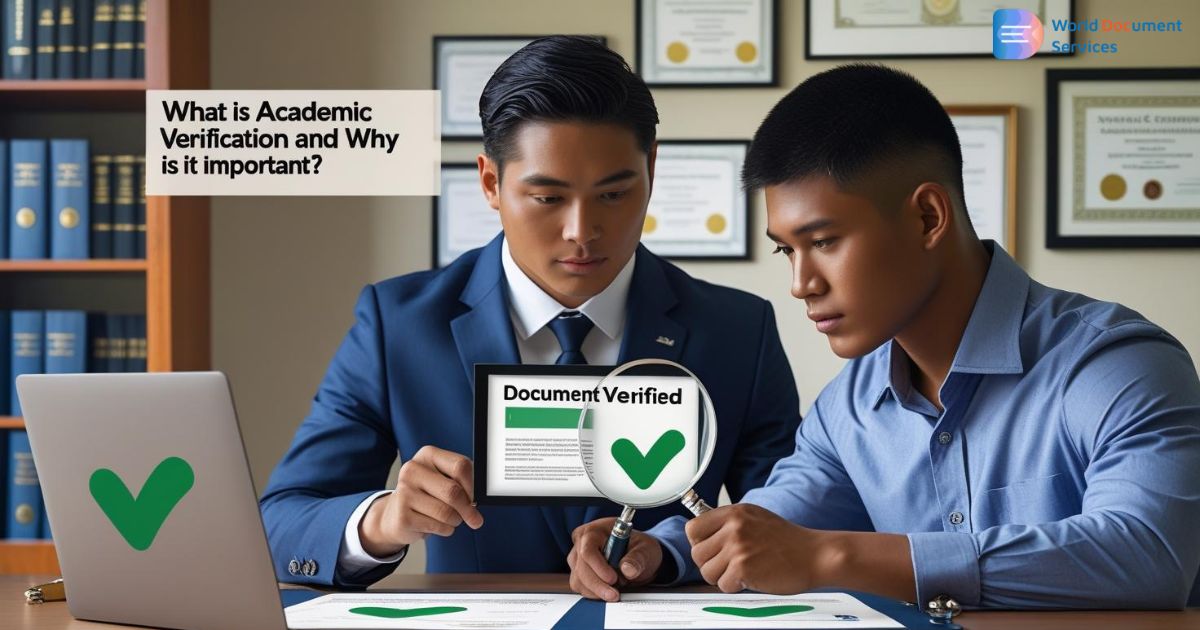
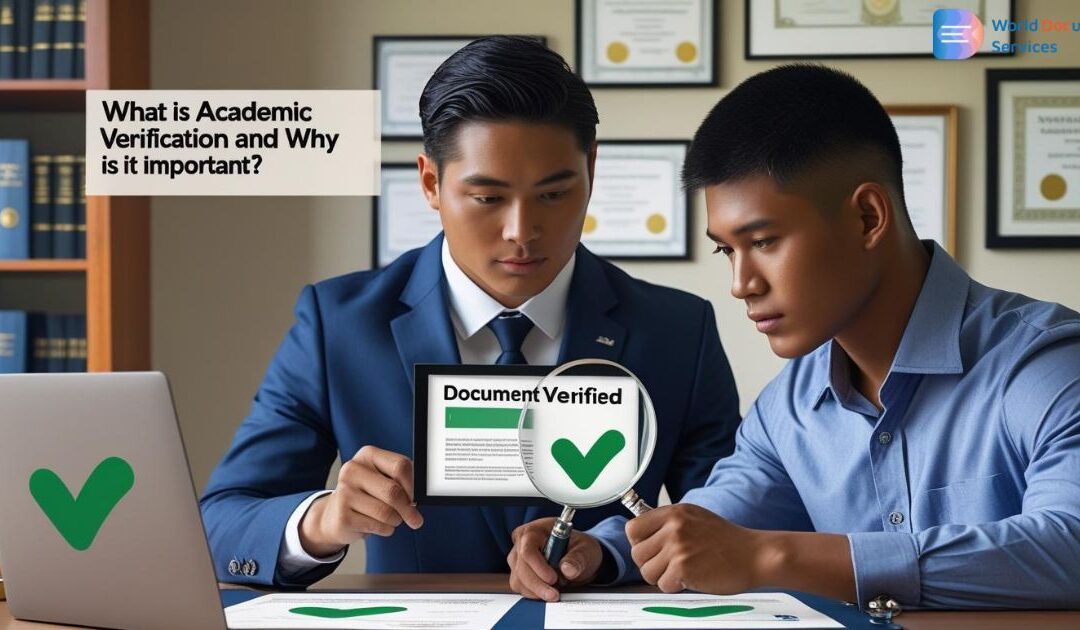
In the academic and professional worlds today, verifying educational qualifications becomes more critical. It could be for higher education, scholarship schemes, or an employment opportunity where the authenticity of academic records would be crucial. Here, it is important that academic verification plays a pivotal role. Academic verification is a procedure that verifies an individual’s legitimate educational qualifications, including degrees, diplomas, or transcripts.
World Document Services is the world’s largest and most prominent academic document verification service. They streamline the process to ensure your academic credentials are accurate, authentic, and recognized by educational institutions and employers across the globe.
Need help with your Academic Verification Process? Contact Us Now!
What is academic verification?
Academic verification is a process in which the academic credentials of an individual are verified with the issuing academic institution. It is ensured that the academic documents—such as transcripts, diplomas, and certificates—are authentic and correctly represent the academic achievements of the individual.
This step usually includes:
- Authentication of Degree: Verifying that the degree or certificate was indeed awarded legitimately.
- Verification of Course Completion: Ascertaining that the courses mentioned were completed.
- Cross-verification of marks or grades: ensuring that the grades or marks provided are accurate.
Sometimes, this verification is necessary between employers, universities, or immigration authorities to avoid false claims and ensure applicants meet certain qualification requirements.
Why is Academic Verification So Important?
1. Helps in avoiding fraud related to academic qualifications
As there is an increased level of fraudulent academic documents, the learning institutions and employers are cautious. Verification of academic credentials ensures that the applicants present original and legitimate qualifications. This protects the organizations from employing or admitting individuals with forged qualifications.
2. Trust and credibility are built
Verified academic credentials build trust between the applicant and the organization. Be it applying for a job, admission to a university program, or a visa, presenting verified academic credentials is proof of one’s credibility and professionalism.
3. Facilitates Admission to Universities
Most universities are very strict in admitting students by first confirming academic credibility, and thus, verification of academic records is recommended. Verifying academic records helps an institution determine if the applicant meets the set academic requirements for a certain program.
4. Visa, Immigration, etc., for a Move Abroad
For students or professionals seeking a move abroad, it often requires verified academic records for immigration, visa processing, or international admissions. Academic document verification ensures your qualifications are valid and recognized globally.
5. Employment
Specialized industries like healthcare, engineering, and law require proof of educational qualifications. Verified academic records ensure that candidates have the right credentials for their jobs.
6. Professional Licensing and Certifications
Many professional bodies only issue licenses or certifications after verifying your academic documents. World Document Services verifies your credentials, thus opening the doors to professional qualifications.
7. Scholarship and Financial Aid Applications
It facilitates scholarship and financial aid applications. There is verification of academic excellence before disbursing financial aid. Verified academic documents are proof of such academic achievements that increase the chances of getting funded.
How World Document Services Simplifies Academic Verification
World Document Services is a well-trusted company dealing in all academic verifications. It facilitates the verification of educational qualifications for individuals and organizations in a proper and efficient way. Its services include the following:
International Academic Verification
World Document Services collaborates with universities and educational institutions worldwide in the verification of academic records to be used locally and internationally.
Safe Handling of Documents
Security is paramount. World Document Services employs secure, encrypted systems in handling sensitive academic documents to ensure confidentiality and data protection in the verification process.
Zero Error Verification
Their professional team checks and verifies your documents thoroughly, reducing errors and ensuring that your records are accurate and complete.
Direct Delivery to Institutions
Most institutions require that these transcripts and certificates be sent directly. World Document Services delivers your documents straight and safely to the intended educational institutions.
Real-time Tracking
World Document Services follows up on the verification of documents in real-time. You find out at each stage, with the confidence you’ll get from their process.
Rapid and Prompt Service
World Document Services is keeping up with expediting the timely processing of certified documents well ahead of submission deadlines.
Accessible Academic Verification: On-the-go Convenience
It becomes even much easier with easy access to World Document Services—through a conveniently downloadable mobile application on iOS as well as an Android device through which you would be able to upload your academic record for verification through our services quickly, track what is happening every step of the way, and get instant notifications and updates.
- Have access to any questions or issues.
You can download the mobile application from the App Store or the Google Play Store and have a smooth experience. It is available for Android as well as iOS devices.
FAQs
Q: What is academic verification?
A: It is the procedure of verifying the authenticity of educational qualifications, like degrees, transcripts, and certificates, with the issuing institution.
Q: Why is academic verification important for university applications?
A: It ensures that your qualifications are authentic and meet the eligibility criteria for university admissions, reducing the risk of fraudulent claims.
Q: How does World Document Services verify academic records?
A: World Document Services contacts the issuing institutions directly to verify the authenticity of your academic credentials and guarantees that documents are processed and submitted securely.
Q: Can I track my verification status?
A: Yes. You can always check on your document verification in real-time with World Document Services by using their mobile app.
Q: Is my verification secure?
A: Absolutely. Through encrypted systems, World Document Services ensures the safeguarding of sensitive academic information about you at each point during verification.
Q: How long will it take for my academics to be verified?
A: Well, there’s a time-to-process variable here, but at World Document Services, the efficiency and prompt verification will be undertaken to ensure one meets critical deadlines in time.
Q: Is World Document Services able to aid in international applications?
A: Yes. They can validate academic documents from both the higher education sectors locally and the requirements of a given university or immigration abroad.
Conclusion
Academic verification refers to the authenticity test of qualifications undertaken in higher learning, employment, or international application processes. This authenticates that credential fraud may not creep through to any particular institution and/or employer as there is a due requirement.
World Document Services makes it easy with safe, accurate, and efficient academic document verification solutions that range from global verification to secure document handling and real-time tracking.
Download the World Document Services App.
You may enjoy a hassle-free experience by downloading our mobile app from either the App Store or the Play Store. It works with both iOS and Android devices.
Let World Document Services ease your academic journey and make it much more secure!
by World Document Services | Aug 4, 2025 | Document Verification
In this generation and era of professionalism, ensuring the reliability of potential employees has become a challenge. Organizations have their focus mostly on ensuring that the employees they hire are most qualified for the role and are reliable for the organization. University degree verification is an important step in ensuring that the organization doesn’t hire any underqualified candidate who can affect the reputation of the organization or is a resource of no use. This step protects the organization from fraudulent claims while also ensuring the integrity of the recruitment process.
Need help with your University Degree Verification? Contact Us Now!
1. Confirms the authenticity of educational credentials
For the matter of the accuracy of degree certificates to evaluate an applicant’s qualification. Fake documents or unverified documents are not very uncommon, and verifying one’s credentials ensures that they have genuinely earned their degrees and certificates. This step helps in hiring individuals with accurate qualifications and ones that organizations can rely on.
2. Reduces the risk of fraudulent hiring
Fake educational credentials have become very common in recent days. As there are rising cases of fake degrees and certificates, it becomes difficult for one to just rely on documents that are available. An effective educational verification process helps employers to hire better employees, and with it, they can authenticate the documents as per the requirement without compromising the hiring process.
3. Ensures compliance with legal requirements
Industries like healthcare, education, and engineering have very strict guidelines and compliance regarding the qualifications of any individual wanting to work abroad. Verifying the academic credentials helps organizations understand and check whether the applicant meets certain criteria, which are required for the job to be done.
4. Enhances workplace productivity
Hiring candidates with authentic qualifications helps to understand and ensure the skills required to perform the tasks being assigned. This contributes to fostering a healthy competition, which also enhances the overall productivity and efficacy of the workplace as a whole.
5. Protects the company’s reputation
Employees are the representatives of their employers and the organization they work for. Hiring employees with no solid background or without proper university degree verification can lead to scandals or affect the company’s credibility.
6. Helps Identify the Best Fit for the Job
The educational verification process is not just about filtering the candidates with unauthentic credentials, but also ensuring that the candidate who possesses the specific educational qualifications gets the role. This ensures that the job is aligned with the skills the job requires and the skills individuals hold. Making sure the one with authentic skills and fair means gets through the jobs.
7. Saves Time and Resources in the Long Run
It does seem time-consuming to get your educational credentials verified, but it saves the organization’s resources in the long term. Verifying the educational credentials and hiring people may seem like a challenging task, but replacing the resources with false information is even more challenging and costly. Hiring people based on their qualifications and verified credentials can prevent any such errors upfront, minimize employee turnover, and balance the cost associated.
8. Builds trust among employees and stakeholders
A company that hires through transparent means, including academic credential verifications, has built trust among its employees, clients, and stakeholders. This trust is important in a certain way, creating better coordination and a reliable work environment.
9. Prepares for International Hiring Standards
Hiring across the globe is a trend and isn’t restricted to just one place now, thanks to globalization. This makes degree certification even more important, as international documents might be difficult to validate without a structured verification process.
10. Mitigates Financial and Operational Risks
Loss of resources is a financial loss as well. In certain cases, it has been seen that people who are underqualified lead to financial loss, which can be in any form, such as project delays or operational mishaps. Specifically in industries like healthcare, inadequate knowledge can lead to severely unacceptable outcomes. Hence, university degree verification eliminates such risks by ensuring that the employees being hired must carry the required qualifications.
How the Education Verification Process Works
1. Candidate Consent
The process begins when the employer updates the candidate about the educational verification process and seeks approval to verify their credentials.
2. Document Collection
The collection of documents is the second step, which is either performed by the employer or the agency. They require copies of the degree certificate, transcripts, and other supporting documents.
3. Contacting Educational Institutions
To verify the documents and certificates, you must reach out to the respective educational institution to confirm the authenticity of the documents.
4. Verification Report
Once the entire verification is done, a report is generated mentioning all the data collected, and then it is either sent to the employer or used by them to make the final call.
Challenges in University Degree Verification
Academic credential verification is of the utmost importance; it comes with its own set of challenges. Which are as mentioned:.
Verifying educational credentials can be time-consuming, especially when dealing with international qualifications.
Some universities may be slow to respond to verification requests, which can cause delays.
The verification process may require the intervention of a third party and hence can add to the cost of verification as well as to the cost of recruitment.
Conclusion
University degree verification is an important part of today’s recruitment process. It is simply unavoidable, as it safeguards both employees and employers in their best interests. Majorly for the employers, it helps to avoid potential fraud, ensures compliance with industry standards, and protects their reputation, but also builds a foundation of trust for long-term success.
In a world where educational credentials are increasingly called into doubt, authentication is no longer optional but paramount when it comes to the degree certificate.
To obtain any assistance in regard to your educational document verification or to address any other questions regarding the same, you can contact World Document Services.
To get any support in your educational document verification or to resolve any queries related to the same, you can reach out to World Document Services. We are experts in the area of document procurement as well as getting it verified.
Download the World Document Services App.
You may enjoy a hassle-free experience by downloading our mobile app from either the App Store or the Play Store. It works with both iOS and Android devices.
FAQs:
Q: What is university degree verification?
A: University degree verification is a process of verifying the credentials and authenticity of the degrees awarded by the issuing institution to a candidate.
Q: Is international qualification degree verification possible?
A: Yes, there are many third-party verification agencies that can verify international educational qualifications to the requirements of the employer.
Q: How long does the education verification process take?
A: The time taken would again vary with the responsiveness of the educational institute and the complexity of the candidate’s qualification.
Q: Which challenges do employers face regarding the verification of degree certificates?
A: Most common challenges include long waiting times from unresponsive institutes, problems in checking old qualifications, and extra charges when a third party is opted to verify the degree certificate.
Q: How do candidates ensure smooth verification?
A: They must provide correct information, be available with their degree certificates at the time of request, and grant permission quickly when sought.
by World Document Services | Jul 10, 2025 | Certificate Attestation
In the global academic and professional spheres today, credential verification is more than just a formality; it’s a necessity. It doesn’t matter whether you’re applying for postgraduate studies overseas, applying for a government job, or moving to another country to accept a job offer; university degree verification is a fundamental way of demonstrating your academic legitimacy.
This guide is meant to support you in understanding the degree verification process, explaining the criticality of verification of academic credentials, and demonstrating ways to expedite the verification process using online degree verification solutions. When you finish reading this, you’ll know what you are looking for, how to complete it quickly and efficiently, and how to avoid many of the common mistakes that delay or stagnate thousands of students from degrees each year.
Need help with your University Degree Verification? Contact Us Now!
What is university degree verification?
University degree verification is a formal process in which the educational institution authenticates a student’s degree or academic record; the rate at which verification occurs can vary. Verification can include authentication of a degree certificate, mark sheets, and all supporting documents issued by a university. Most verification comes from employers, embassies, verification agencies, or other educational institutions.
Why is it important?
With a digital age and competitive market, there are many fake degrees and fake educational records. Institutions and employers want to ensure that the documents you present are legitimate and issued from a certified entity.
Understanding the Degree Verification Process
The degree verification process generally follows these core steps:
- Submission of Application: Students or third parties (like verification agencies) must submit a formal request to the university along with necessary documents.
- Document Review: The university examines the submitted credentials to ensure they match their official records.
- Authentication and Endorsement: If verified, the university stamps or seals the document as “Verified” or provides a formal verification letter.
- Dispatch or Upload: In some cases, these documents are physically couriered to the requesting authority. Increasingly, however, this is done through degree certificate verification online portals.
This process can vary depending on the country, university, and the nature of the document.
Shift Towards Online Degree Verification
Many institutions and countries have shifted to online degree verification systems. These platforms allow students, alumni, and verification agencies to access secure databases that confirm educational records in real time.
Some prominent platforms include
- National Academic Depository (NAD) in India
- Digilocker Integration for University Certificates
- Student Clearinghouse in the United States
- WES (World Education Services) for international credential evaluation
- In-house university document verification portals managed directly by institutions
Benefits of degree certificate verification online include
- Faster turnaround time
- Digital and paperless transactions
- Reduced risk of lost or forged documents
- Secure access control
- Compliance with global verification standards
If your university is not yet online, you’ll need to rely on traditional manual processes.
What is Academic Credential Verification?
Academic credential verification is a broader term that includes verifying not just your degree certificate but also:
- Transcript/Marksheet verification
- Course completion certificates
- Medium of Instruction (MOI) letters
- Provisional degrees
- Revaluation letters (if applicable)
- And any academic documentation tied to your credentials
This step is vital when you’re planning to study or work abroad, especially in countries like Canada, the U.S., Australia, and Germany, which require credential equivalency evaluations.
How to Initiate University Document Verification
Follow these best practices to ensure smooth university document verification:
- Know the Requirement: Understand whether the end institution requires original verified documents, soft copies, or attested versions.
- Prepare Your Documents: Keep your degree, marksheets, ID proofs, passport copies, and application forms handy.
- Use Official Channels: Always request verification through your university’s registrar office or official website. Avoid third-party agents unless they are officially authorized.
- Track Your Application: If online portals are available, use tracking features. If not, maintain communication via email or phone with university personnel.
- Pay the Fees Promptly: Some universities charge a nominal fee for processing verifications or couriering documents abroad. Ensure you make timely payments to avoid delays.
Common Pitfalls to Avoid
- Incomplete Applications: Even a single missing document can delay the process.
- Wrong Authority Contacted: Always verify the designated contact point at your university.
- Procrastination: Initiate the verification process at least 1-2 months before your deadline.
- Not Cross-Checking the Format Required by the End-User: Some embassies or companies require sealed envelopes; others demand digital signatures.
Conclusion:
In the digital age, university degree verification is more accessible yet more critical than ever. Whether you’re dealing with academic credential verification for international study or online degree verification for employment purposes, a well-prepared and strategic approach can save you time, money, and unnecessary stress.
Always stay informed about your university’s verification mechanisms. And most importantly, treat your academic documents with the same level of seriousness as your passport or visa. They are your educational identity in the global marketplace.
Download the World Document Services App
You may enjoy a hassle-free experience by downloading our mobile app from either the App Store or the Play Store. It works with both iOS and Android devices.
Frequently Asked Questions (FAQs)
Q: How long does the university degree verification process take?
A: Typically, 10 to 30 working days, depending on the university and mode (manual or online). Delays are common during peak academic seasons.
Q: Can I verify my degree online if I graduated several years ago?
A: Yes, many universities offer online degree verification even for alumni. However, you may need to update your student profile or contact the registrar.
Q: Is notarization the same as academic credential verification?
A: No. Notarization only confirms your identity and the authenticity of the document copy, not the academic content or issuance by the university.
Q: Can I send verified documents directly to a third-party institution, or does the university need to send them?
A: It depends. For most embassy or credential evaluation agencies, the documents must be sent directly by the university in a sealed envelope or secure digital channel.
Q: What if my university doesn’t offer online verification?
A: In such cases, you’ll need to go through manual routes—submitting physical copies and using postal services or authorized agents recognized by the university.
by Shipra Choudhary | Apr 7, 2025 | Most Viewed, Online Transcript Services
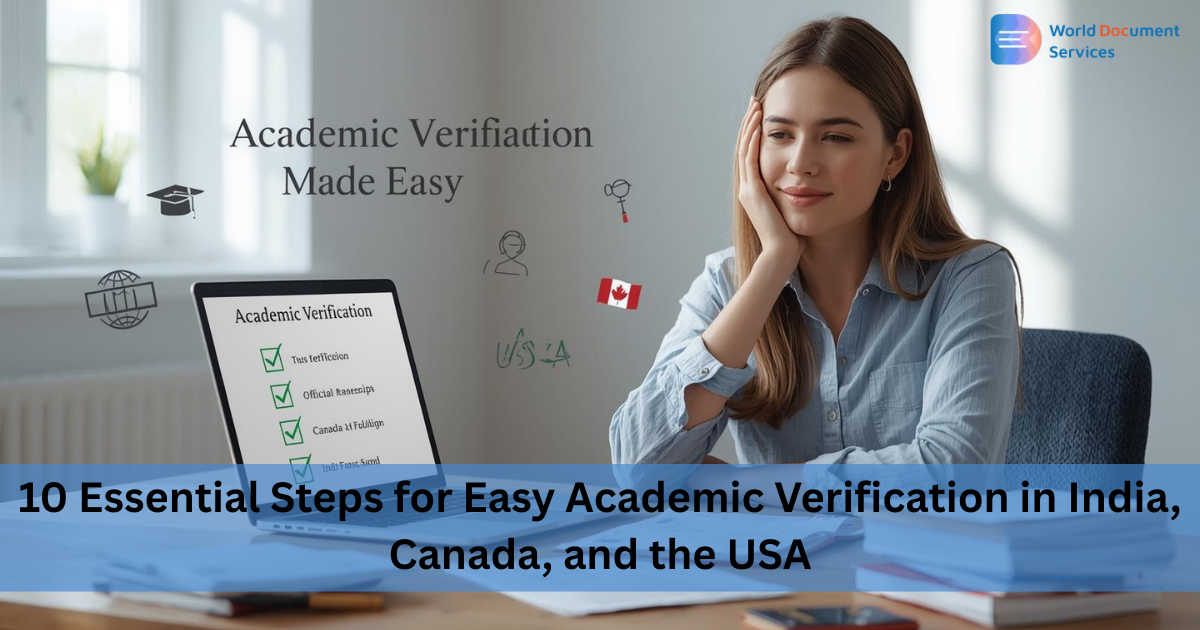
One of the most important steps that foreign students, professionals, and job seekers need to undergo is academic verification. Making sure that your academic credentials are checked properly is important for your future, whether you’re applying for college, a job, or a visa. This blog post will talk about 10 important steps that make it easy to check your academic credentials in places like India, Canada, and the USA. This guide will show you the steps you need to take to make sure that the process of verifying your academic transcripts and credentials goes smoothly.
Need help with your Academic Verification? Contact Us Now!
Why is Academic Verification So Important?
Verification of your academic details or you can simply say the process of academic verification is important because colleges, companies, and immigration departments make sure that your official academic records, like transcripts, degrees, and diplomas, are genuine. Your application for college, a job, or immigration could be rejected if you fail to present proper documentation. It’s important to ensure that you are who you say you are, it’s like the foundation of your education!
Okay, now that we know what’s going on, let’s get into the 10 steps that will help you get through the process of verifying your academic documents, whether you’re enrolling in in the US, Canada, or India.
Read more: The Essential Guide to University Certificate Verification for Overseas Education
1. Start Early: The Key to Smooth Verification
Students often make the mistake of waiting until the very last minute to start the process of academic verification. Start early if you want to apply for a job, a visa, or an academic institution to study abroad. Different institutions have their own different way of handling the documents and starting the process, so in order to avoid unnecessary stress, starting early is the best thing you can do for yourself . Try to start the process at least 6 to 8 weeks before the date for your application.
2. Understand the Different Types of Academic Verification
Academic verification isn’t just one-size-fits-all; there are various types of verification. Knowing which type you need will save you time and ensure you’re getting the right documents in order. Here’s a breakdown:
- Transcripts Verification: Here, authenticity of your official transcripts is verified by providing a detailed account of your courses and grades.
- Degree Verification: If you have a degree or a diploma that needs to be verified then you should go for this.
- Diploma/Certificate Verification: Here, certificate or diploma holders can be benefited as this verification ensures that these are genuine and issued by the institution.
3. Gather All Necessary Documents
The next step in the academic verification process is to collect all the necessary documents. Make sure you have the following:
- Original Transcripts from your educational institution.
- Degree Certificates proving your academic qualifications.
- Proof of Identity (passport, ID card, etc.), especially for international verifications.
Having these ready will save you time later. Some institutions or third-party services may even allow you to submit your documents online, making the process faster and more convenient.
4. Reach Out to Your Educational Institution
Once you have all of your documents together, you should reach out to the college where you’re studying or studied. Most of the universities and colleges have departments that only deal with requests to verify academic credentials. You can contact them via their website, email address, or even their helpline number.
You just need to make sure that you provide all the correct information– student ID, the name of the college where you were enrolled, and the year you graduated. By doing so, the entire process will be easy as they can find your information quickly, which speeds up the verification process.
5. Use a Trusted Third-Party Verification Service
If you want the process to go smoothly, you could choose to opt for a reputable third-party verification service like World Document Services (WDS) — they are experts at handling the process of verifying transcripts and can help you with the tricky parts of verifying academic credentials. Instead of going through all the hassle, it is better to choose a third party service.
Not just the process but it will also save time, lowering the risk of mistakes and delays as they know the whole process better than us– handling foreign credential verification for studying abroad or making sure all of your documents meet the requirements.
6. Understand International Verification Requirements
The process of academic verification can be different from one college to another and now here we are talking about the international academic verification process, how can we expect it to be a piece of cake? If you are applying for universities or jobs in countries like Canada or the USA, the requirements might differ from those in India. For example, in Canada, the World Education Services (WES) plays a key role in verifying your academic documents, while in the USA, organizations like the National Student Clearinghouse are typically used.
7. Know the Processing Time for Verification
Before you start the process of verifying your educational credentials, you should know how long it will take. These waiting periods can change depending on the location, the organization, and the type of verification. Verifications can take anywhere from a few weeks to a long time.
8. Check for Any Required Additional Documents
In some cases, the verification process may demand additional documentation. Universities or employers may ask for official stamps, sealed envelopes, or translations of your academic papers that have been verified for accuracy if they are not in English. Always ask if there is any extra paperwork that needs to be filled out. Ignoring this can cause delays which are not mandatory.
9. Ensure the Legitimacy of Your Documents
Remember that the main objective of academic credential verification is to be confident that your academic documents are authentic. So, make sure that whatever documents you send are genuine and haven’t been changed in any way. If you had to ask for a new copy or a reprint, make sure that these are official copies that were sent to you by the institution you attended.
10. Stay Updated and Follow Up
Maintain close tabs on the process once your academic documents are being verified. You can check back often to see what’s going on with your application because many organizations and verification services let you see where your application is at the moment. If problems happen, like missing documents or mistakes in your information, you should move quickly to avoid delays and keep things going smoothly.
Read more: Navigating the Document Verification Process for Canadian Universities
Conclusion: Streamline Your Path to Success!
The process of academic verification doesn’t need to be complex. If you do these 10 essential tasks, you can be sure that your academic credentials have been evaluated thoroughly and that you are ready for your next big shot. Assessing your academic records is an important step in the process whether you’re applying to college, looking for a job abroad, or getting ready to immigrate.
The process can be a lot easier to handle if you start early, know exactly what you need, and use reputable services like World Document Services (WDS). If you do things the right way, your academic verification will go smoothly, on time, and without any extra stress.
Visit World Document Services (WDS) today to get expert help with verifying your academic credentials and making the process of verifying your transcripts easier. This is the first step toward your global possibilities!
Download the World Document Services App
You may enjoy a hassle-free experience by downloading our mobile app from either the App Store or the Play Store. It works with both iOS and Android devices.
FAQs
Q: What is the Difference Between Degree Verification and Transcript Verification?
A: Degree verification —attempts to see if the credentials or degree you say you have is legitimate and comes from a recognized educational institution. While transcript verification —examines the academic records, such as courses, grades, and credit hours, to make sure they match what was given about the student’s academic background.
Q: Do I Need Academic Verification for Jobs Abroad?
A: Yes, verification of your educational accomplishments is often needed when applying for work abroad. In the USA, Canada, and the UK, for example, employers will often ask to see proof of your college credentials to make sure that the skills you list on your cover letter are real.
Q: Can I Verify My Academic Credentials Online?
A: Yes, you may undertake the process of verifying your academic documents online with numerous educational institutions and third-party services. Some services, like World Document Services (WDS), let you upload your educational documents digitally so they can be checked— making the process faster and easier.
Q: What Happens if My Academic Documents Are Found to Be Fraudulent?
A: You can land up in jail in the worst scenario but one thing is for sure— your educational or professional career is finished. Educational institutions or companies may turn down your application, and you may not be able to apply for jobs or educational institutions in the future.
 +91 62 3267 0879
 Call Us
 Mail Us
 WhatsApp